Shanghai Tour 9 - Nanjing Road and the Riverside
- yam-wanngan
- Feb 9
- 9 min read
Join us on a journey through the vibrant streets that tell the story of Shanghai’s modern history, all while offering breathtaking views of the riverside. From the bustling energy of Nanjing Road to the iconic skyline of the Bund, this walk captures the very essence of the city.
Total Distance: 7.1 km (57.1 km personally) | Total Hours: 8 Hours (Light Biking, Heavy Touring)
Main Destinations:
West Nanjing Road (南京西路)
Nanjing Road Pedestrian Street ( East Nanjing Road) (南京路步行街)
The Bund (外滩)
The Ferry (轮渡)
Lujiazui (陆家嘴)
Map:
Main Blog:
On the first day of 2026, Bike in Shanghai kicked off the new year with its very first ride, exploring two of the city’s most iconic areas—Nanjing Road and the Bund.
West Nanjing Road (南京东路)
West Nanjing Road marks the western stretch of this iconic Shanghai avenue, running through the Huangpu District and passing a blend of historic landmarks and modern hotspots. Along the way, you’ll find treasures like the Shanghai History Museum as well as trendy destinations such as HKRI Taikoo Hui, making it a perfect mix of culture and contemporary style.

I started my journey at the Starbucks Reserve Roastery, where a long line of people queued up to go inside. This isn’t just any coffee shop—it’s one of the largest Starbucks locations in the world, a sprawling 30,000‑square‑foot “coffee theater” that opened in 2017 as the company’s biggest store at the time. With its towering two‑story copper roasting cask and the world’s longest Starbucks coffee bar, the space feels more like an immersive coffee wonderland than a café.
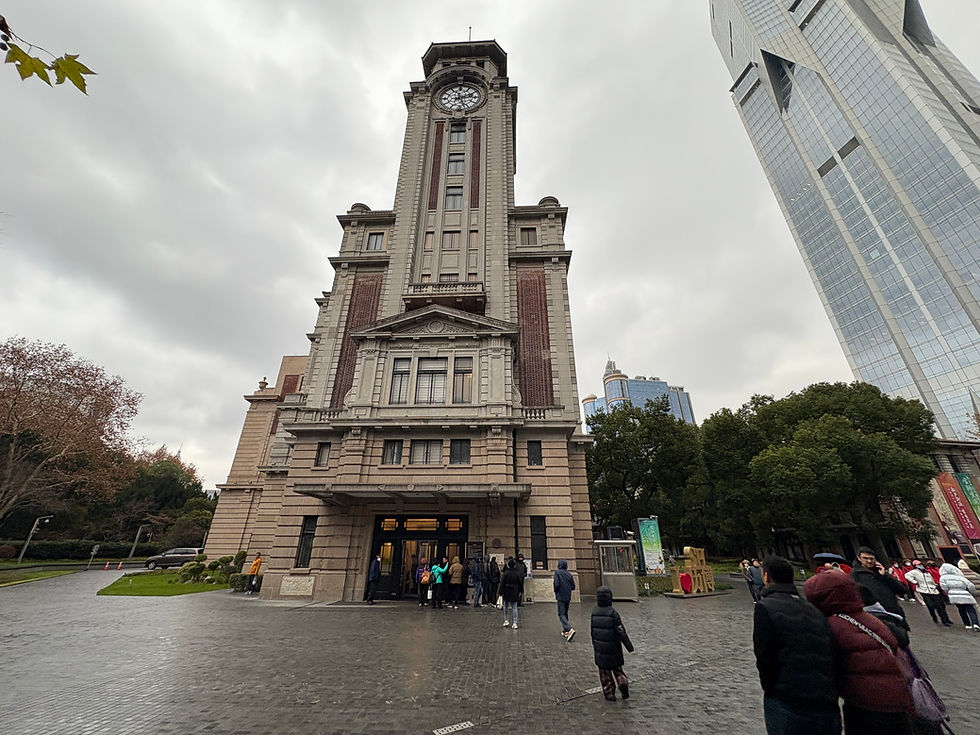

As I biked eastward, the crowd thinned out for a moment, giving me a brief stretch of quiet before I rolled up to the Shanghai History Museum—another major draw for visitors. Housed in the historic former Shanghai Race Club building, the museum holds more than 30,000 artifacts and traces the city’s story from the opening of Shanghai as a treaty port in 1843 through the mid‑20th century, featuring everything from Opium War cannons to the bronze lions that once stood at the old HSBC Building on the Bund.

Next up is the iconic bend of the road as it meanders north, passing People’s Park on its south side—a lush urban oasis built in 1952 on the former Shanghai Race Club grounds and now home to museums, pavilions, and the city’s famous weekend marriage market. To the north, the road is flanked by two architectural gems: the historic Grand Theatre, a 1932 Art Deco cinema designed by architect Ladislaus Hudec and once one of Shanghai’s most glamorous movie houses, and the International Hotel (Park Hotel), a landmark Art Deco tower completed in 1934 that was the tallest building in Asia for nearly three decades.
After continuing along West Nanjing Road and stopping at Middle Xizang Road, I had to hop off our bikes to navigate the real spectacle of the day: the bustling Nanjing Road Pedestrian Street.
Nanjing Road Pedestrian Street (南京东路步行街)
A vibrant corridor where modern storefronts meet historic façades, creating a dazzling showcase of the city’s energy and style.

With slippery bricks beneath my feet and a light drizzle falling overhead, I continued forward, passing the giant Shimao Festival City mall that towered beside me. The pedestrian street was buzzing with tourists, umbrellas bobbing through the misty air. But the malls held little appeal for me—Shanghai has plenty of them, and they rarely feel authentic. I was far more interested in the street itself, with its mix of sounds, colors, and everyday chaos that gives Nanjing Road its real character.

Further down the street, the scene shifts into a stretch filled with eateries offering a variety of local dishes—some of which can be absolutely fantastic. What really stood out, though, was the view. From here, you can see a surprising number of Shanghai’s skyscrapers rising above the old colonial‑style buildings, pulling your attention upward and away from the traditional facades below. Ironically, many of those historic buildings are now packed with modern brands, but that contrast feels completely normal here. After all, this has been one of Shanghai’s busiest, most crowded, and most iconic areas for more than a century.

Want to take a look at the newest iPhone while you’re here? Just keep walking and you’ll run straight into a surprisingly large Apple Store. Right across from it sits a Samsung store, and a little further down the street you’ll spot Huawei as well. All three make an appearance in the photo—proof that even in one of Shanghai’s oldest commercial districts, the tech giants still steal the spotlight.

The Bund (外滩)
A grand riverside promenade lined with colonial façades, where stately architecture meets the shimmer of modern skyscrapers across the water.


Now, the further you go, the more historical monuments begin to appear. The street suddenly feels like a set from a World War II film, and right to your left rises one of Shanghai’s most iconic landmarks: the Peace Hotel. Originally opened in 1929 as the Cathay Hotel, this Art Deco masterpiece was built by Sir Victor Sassoon and quickly became known as the most luxurious hotel in the Far East. Its distinctive green copper pyramid roof still defines the Bund skyline today. The building once hosted a glamorous international crowd—politicians, diplomats, celebrities, and writers. Even Noël Coward famously completed his play Private Lives here while bedridden with the flu. Inside, themed “national suites,” silver‑tapped marble baths, and state‑of‑the‑art amenities like air‑conditioning made it a marvel of modernity in its time.

Directly opposite, on your right, stands the Swatch Art Peace Hotel, occupying what was once the 1908 Palace Hotel—the tallest building on Nanjing Road in its day. Today, the building serves a completely new purpose: it is an artist‑in‑residence hotel run by The Swatch Group. Behind its Victorian‑era façade, the upper floors now house 18 workshop‑apartments where artists from around the world live and create for three to six months at a time. Since opening the residency in 2011, the hotel has welcomed more than 600 artists from over 60 countries. Its ground floor hosts luxury watch boutiques from brands like Omega, Blancpain, and Swatch, while its restored interiors still reflect the building’s role in significant historical events, including hosting the 1909 International Opium Commission.

As the crowd thickened around me, the skyline began its slow reveal. Between the gaps of old façades and modern storefronts, one by one, the Lujiazui “Three‑Piece Suit” (陆家嘴三件套) rose into sight — Shanghai’s most famous architectural trio.

First to appear is usually the Shanghai World Financial Center, instantly recognizable by its rectangular opening at the top — a design feature that earned it the nickname “the Bottle Opener.” With its razor‑sharp silhouette and 101 floors, it stands at 492 meters, making it one of the tallest skyscrapers in the world.
Next comes the Jin Mao Tower, a striking contrast in style. Completed in 1999, this 420.5‑meter, 88‑floor tower was designed to echo the tiered form of traditional Chinese pagodas. Its layers rise in a rhythmic, stepped pattern that feels both ancient and futuristic — a perfect symbol of Shanghai itself.
And finally, towering above them all, the Shanghai Tower spirals into view. At 632 meters, it’s the tallest building in China and the third‑tallest building on the planet. Its twisting form reduces wind resistance and gives the impression that the tower is rising into the sky like a ribbon of glass.
Locals affectionately call these three skyscrapers a “three‑piece suit” because together they look like a matching set — each with its own personality, yet perfectly complementing the next. Standing across the river, watching them emerge one after another, you really understand why this skyline appears on nearly every Shanghai postcard.
To really soak in the view, we crossed the road and stepped onto the Huangpu River sightseeing platform. From here, the panorama finally opens up — the colonial Bund behind you, and the futuristic Lujiazui skyline directly across the water, facing you like a scene straight out of a sci‑fi movie.
And of course, standing proudly among these architectural giants is the unmistakable Oriental Pearl Tower, one of Shanghai’s most iconic landmarks. Completed in 1994, the tower rises 468 meters above the Huangpu River and was the tallest structure in China for over a decade. Its design—eleven spheres of different sizes stacked along three massive columns—was inspired by a line from a Tang Dynasty poem describing “big and small pearls falling onto a jade plate,” giving the tower its poetic, pearl‑like silhouette. Inside, it’s not just a broadcast tower but a full visitor playground: a revolving restaurant, multiple observation decks including a glass‑floor skywalk at 259 meters, and even a Shanghai History Museum at the base. With its futuristic glow at night and its poetic roots in Chinese culture, the Oriental Pearl Tower remains the perfect symbol of Shanghai’s blend of tradition and modern ambition.

Now turn left and you’ll see the bronze statue of Chen Yi (陈毅), a landmark many visitors miss but absolutely worth a pause. Chen Yi wasn’t just any official — he was Shanghai’s first Communist mayor, a highly respected military commander who helped take the city on May 25, 1949 from the Nationalists during the civil war, and later served as China’s Foreign Minister from 1958 to 1972 as well as Vice Premier for much of that period. The statue itself stands 5.6 meters tall and was erected in 1993 overlooking the Huangpu River, replacing an older monument melted down during wartime. Today, it marks the entrance to Chen Yi Square, the only square on the Bund to feature a bronze sculpture—a tribute to a man who shaped Shanghai’s early decades under the PRC and remains deeply woven into the city’s memory.

If you look back now, you’ll see The House of Roosevelt, located in the historic No. 27 Bund building. Originally constructed in 1922 as the Shanghai headquarters of Jardine Matheson, the building is a neoclassical landmark that now houses dining venues, a private club, and what is considered one of Shanghai’s largest wine cellars.
The Ferries (轮渡)
A cheap and effortless way to cross the Huangpu River while enjoying the skyline is by hopping on the public ferry for a quick ride that gives you a whole new angle on Shanghai.
Bund, I continued south toward the ferry. My first stop was the East Jinling Road Pier and Shiliupu Pier, only to realize that the ferry I needed was actually a full kilometer farther down the river. The detour, however, came with its own charm.The sightseeing platform nearby was noticeably less crowded, offering a calmer space to take in the view. A handful of livestreamers added a splash of energy, singing and dancing against the backdrop of the river. Photographers lingered along the railings, waiting patiently to capture portraits for passing tourists. It was a lively yet relaxed scene—Shanghai’s riverside life unfolding in small, spontaneous moments.
The Shiliupu Pier itself offered a curious sight: rows of tourist ferries with bright signage and sleek designs, each promising a journey I couldn’t quite decipher. Their destinations remained a mystery to me, but that uncertainty added to the charm. Watching them dock and depart, I imagined the adventures they carried—perhaps short cruises along the Huangpu, or longer rides weaving past Shanghai’s glittering skyline.Even without boarding, the scene was captivating. The ferries seemed to embody the city’s restless energy, always in motion, always carrying people toward new perspectives of Shanghai’s waterfront.

Arriving at the East Fuxing Road Pier, I finally boarded the ferry. Tickets were surprisingly affordable—just 2 RMB—and payment was simple with the Shanghai Public Transportation card, or by scanning a WeChat or Alipay QR code.

It had been a long time since I last rode a ferry, and the experience immediately brought back memories of Hong Kong’s iconic Star Ferries. This vessel had a lower deck without seats, giving it a more utilitarian feel. I climbed to the upper deck instead, where the open space offered a far better view of the Huangpu River. The breeze carried the scent of the water, and the skyline unfolded in a way that felt both familiar and new.

The ride was remarkably smooth—I felt no nausea or seasickness at all. In barely five minutes, the ferry carried me across the river to Dongchang Road Pier. The short journey was effortless, yet it offered a fresh perspective of Shanghai’s skyline from the water. Watching the city glide past from the deck, I realized how these quick crossings are more than just transportation; they’re a chance to pause, breathe, and see the metropolis from a different angle.
Lujiazui (陆家嘴)
A futuristic financial hub defined by soaring glass towers, dazzling lights, and a skyline that feels like the heartbeat of modern Shanghai.
As soon as I set foot in Pudong, hunger struck, and I decided to head north toward Super Brand Mall for dinner. Inside, I quickly found the massive wall displaying every shop’s logo—a helpful guide to locate food options. I settled on Saizeriya, a casual spot serving Italian cuisine, and enjoyed a simple meal that refueled me for the evening ahead.

By the time I finished eating, the sky had already darkened, urging me to continue my journey quickly. I made my way to the Minzhu Roundabout, where one of Shanghai’s most spectacular nightscapes unfolded before me. An elevated overpass connected the surrounding malls to the Oriental Pearl Tower, its futuristic silhouette glowing against the night sky. The tower, famous not only as a landmark but also as a broadcasting hub, seemed to anchor the entire scene.Inside, an elevator carries visitors to the top, offering sweeping views across the city. I chose not to go up this time—it was already late—but even from below, the illuminated skyline was unforgettable.


After a long day, I was finally ready to head back to Puxi, cycling 20 kilometers home. The ride felt like a quiet conclusion to the adventure—city lights fading behind me, the river crossing still fresh in memory, and the rhythm of the pedals carrying me back through Shanghai’s streets. It was the perfect way to close out a journey that had blended history, skyline views, and riverside life into one unforgettable day.
This marks the end of our ninth Shanghai tour, and I hope you all enjoy it as much as we did. As always, stay tuned for our bimonthly trip updates!


Comments